
AFM AS A SUSTAINABLE REPLACEMENT FOR UF SYSTEMS
INTRODUCTION
Drinking water treatment plants are essential for delivering safe and potable water. Traditionally, Ultrafiltration (UF) systems have been implemented for advanced treatment. However, the associated high capital and operational expenditures often challenge the economic viability of these systems. This innovation presents a comprehensive techno-commercial comparison of Activated Filter Media (AFM) as a cost-effective replacement for UF systems. (Except RO). The study demonstrates how AFM achieves comparable water quality while delivering significant cost savings, making it an attractive solution for drinking water treatment facilities.
BACKGROUND
The existing UF system was in operation for 110m3/hr of surface
water (River/Canal/Borewell). Due to an increase in demand new
plant was proposed with the same technology. The new system
was installed with AFM – Activated Filter Media-based
technology for the same water flow.
TECHNICAL PRINCIPLE OF AFM:
Activated Filter Media (AFM) is a high-performance filtration medium engineered from recycled glass.
- Fine Filtration: Removal of particles down to submicron levels.
- Biofouling Resistance: Inherent self-sterilising properties reduce microbial growth.
- Hydraulic Efficiency: Consistently low head loss and superior flow rates.
- Extended Durability: Chemical and mechanical stability ensure long-term performance.
- Sustainable Product: Produced from Waste Green glass. Zero carbon footprints
PROCESS COMPARISON
| SYSTEM COMPONENTS | UF - ULTRA FILTERATION | AFM (DRYDEN) ACTIVATED FILTER MEDIA |
|---|---|---|
| Pump | Yes | Yes |
| Pre-Disinfection | Yes | Yes |
| Tube Settler | Yes | Yes |
| Media Filter | Yes | Yes |
| Air Scouring System | Yes | No |
| ACF-Activated Carbon Filter | Yes | Yes |
| Softner | Yes | Yes |
| UF SKID & Assembly | Yes | No |
| CIP Cleaning System | Yes | No |
| Inline Antiscalent & Chemical Dosing | Yes | No |
| Post Disinfection | Yes | Yes |
THE AFM BASED SYSTEM ELIMINATED 4 CRITICAL COST INTENSIVE COMPONENTS OF THE PLANT
- Air scouring system for DMF – Backwash
- UF System (110 m³/hr):-UF Modules, Skid, Pumps, PLC Control System,
- CIP system.
- Inline Anti-scalent & Chemical Dosing System.
KEY PERFORMANCE METRICS
PERFORMANCE PARAMETER
| CATEGORY | UF SYSTEM | AFM SYSTEM |
COMPLIANCE STANDARDS |
COMMENTS |
|---|---|---|---|---|
| Turbidity (NTU) | < 0.1 | < 0.2 | < 1.0 | Meets Requirement |
|
Total Suspended Solids -TSS - mg/l |
< 5 | < 5 | < 10 | Meets Requirements |
OPERATIONAL PARAMETER
| Incoming flow - m3/hr | 110 | 110 | 110 | |
| Output | 85 | 104 | 17 % More Output | |
| Hour of Operation | 20 | 23 |
BACKWASH FREQUENCY
| Sandfilter | 12 Hours | 24 | ||
| UF | 1 Hour | NA |
TSS & TURBIDITY COMPARISONS – UF & AFM SYSTEM:
TURBIDITY COMPARISON:

TSS COMPARISON:

COST & OPERATIONAL INSIGHTS - FINANCIAL COMPARISION
AFM (DRYDEN AQUA) IS WARRANTIED FOR A PERIOD OF 10 YEARS
BELOW IS A CAPEX AND OPEX COMPARISON FOR TREATING 110 m³/hr WATER USING THESE TECHNOLOGIES.
1. CAPITAL COST (CAPEX):
UF System (110 m³/hr):
- System includes UF modules, skid, pumps, PLC control system, CIP system, etc.
- CAPEX: ₹1.2-1.8 crores (₹12-18 million).
AFM System (110 m³/hr):
- System includes Media Filtration vessel, sand filter vessel, media (AFM), pumps, and instrumentation.
- CAPEX (including vessel and pumps): ₹0.5-1.0 crore (₹5-10 million).
2. OPERATIONAL COSTS (OPEX):


3. KEY PERFORMANCES DIFFERENCES:

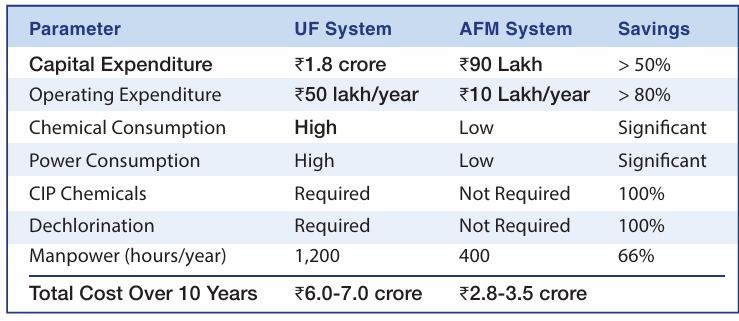
4. COST COMPARISION SUMMARY:
OPERATIONAL BENEFITS:
- CAPEX Reduction: Simplified system design by eliminating UF modules.
- OPEX Efficiency: Substantial savings through reduced energy and chemical usage.
- Maintenance Optimization: Eliminating complex cleaning-in-place (CIP) procedures.
- Enhanced Sustainability: Lower resource utilisation aligns with environmental goals
DETAILED ADVANTAGES OF AFM OVER UF SYSTEMS:
- Economic Feasibility: AFM substantially reduces both capital and operating expenditures. With a simplified process flow and elimination of UF modules, the initial investment decreases by over 50%. Operational costs are also significantly reduced due to lower energy and chemical requirements, contributing to long-term savings.
- Superior Filtration Performance: AFM delivers excellent water quality with turbidity levels of <0.2 NTU, well within drinking water standards. Its ability to remove submicron particles ensures comparable performance to UF systems while avoiding the operational complexities.
- Biofouling Resistance: Unlike traditional sand or UF membranes, AFM resists biological fouling due to its self-sterilising surface. This reduces the need for frequent cleaning, extending the operational life of the system and lowering maintenance costs.
- Energy Efficiency: AFM operates at significantly lower pressure compared to UF systems, reducing energy consumption. This makes it an environmentally friendly option for facilities aiming to minimise their carbon footprint.
- Chemical Reduction: By eliminating the need for dechlorination and reducing coagulant and flocculant dosages, AFM minimises chemical consumption. This not only reduces OPEX but also aligns with sustainability goals by decreasing chemical waste.
- Simplified Maintenance: AFM eliminates the need for complex cleaning-in-place (CIP) processes associated with UF systems. This simplifies plant operations and reduces downtime, allowing for more consistent water treatment.
- Environmental Sustainability: AFM is made from recycled glass, contributing to waste reduction and promoting circular economy principles. Its long lifespan further reduces the frequency of replacement, making it an environmentally responsible choice.
- Versatility in Applications: AFM is suitable for a wide range of water treatment applications, including municipal, industrial, and commercial settings. Its adaptability ensures consistent performance across varying operational conditions.
NEW HYDROPHOBIC SURFACE

CONCLUSION
The integration of AFM in place of UF systems in the 115 m3/hr drinking water treatment plant resulted in substantial economic and operational benefits. With over 50% CAPEX savings and 80% OPEX savings, AFM is a robust, cost-effective alternative that does not compromise water quality or operational reliability. These findings underscore the potential of AFM as a preferred choice for water treatment applications aimed at techno-commercial optimisation.
SUMMARY
These results highlight the transformative potential of replacing UF systems with Activated Filter Media (AFM) in drinking water treatment plants.
AFM offers:
- Comparable water quality with reduced turbidity and suspended solids.
- Over 50% savings in capital expenditure and 80% in operating costs.
- Simplified maintenance, biofouling resistance, and reduced chemical and power consumption.
The results demonstrate that AFM is not only a cost-effective solution but also an environmentally sustainable choice for water treatment facilities. By embracing AFM technology, plants can achieve operational excellence while meeting stringent water quality standards