
Chlorine Dioxide vs UV Water Treatment: Which Is Better For Disinfection?
- The Real Problem With "One Size Fits All" Disinfection
- How Each Technology Actually Works
- Head-to-Head: Where Each Method Wins and Where It Doesn't
- When UV Makes Sense
- When Chlorine Dioxide Is the Better Fit
- The Case for Combining Both
- What This Means for Your Facility
- FAQs
- Protect Your Water the Right Way
Engage With Us
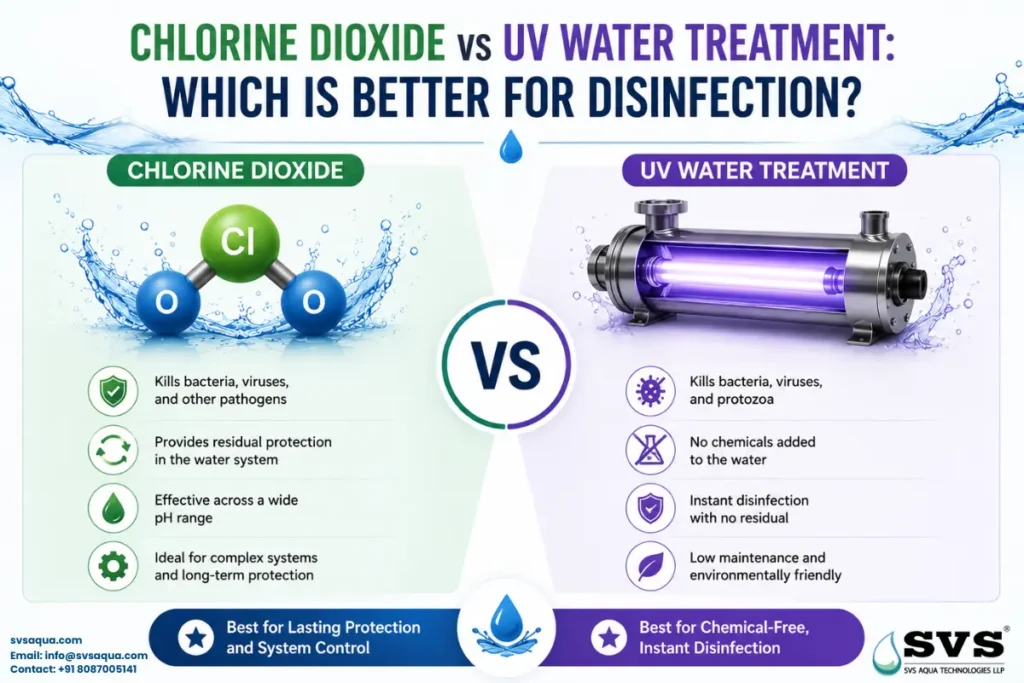
You pick a disinfection method. You install the system. And then six months later, you find out it does not protect against a specific group of pathogens in your water supply. That is a problem no facility can afford, whether you run a food processing plant, a municipal water station, or an aquaculture setup.
The debate around chlorine dioxide vs UV is not just academic. It is a decision that directly affects water safety, operational costs, and regulatory compliance. Both methods work. But they do not work the same way, and choosing the wrong one for your situation can leave real gaps in your water protection.
| Feature | UV | Chlorine Dioxide |
|---|---|---|
| Residual Protection | No | Yes |
| Biofilm Removal | Limited | Strong |
| Chemical-Free | Yes | No |
| Large Pipelines | Weak | Excellent |
- The Real Problem With "One Size Fits All" Disinfection
- How Each Technology Actually Works
- Head-to-Head: Where Each Method Wins and Where It Doesn't
- When UV Makes Sense
- When Chlorine Dioxide Is the Better Fit
- The Case for Combining Both
- What This Means for Your Facility
- FAQs
- Protect Your Water the Right Way
Engage With Us
The Real Problem With "One Size Fits All" Disinfection
Most facilities still rely on a single disinfection technology and assume it handles everything. That assumption is where problems begin.
Water contamination is not a single threat. It includes:
- Bacteria like E. coli and Legionella
- Viruses, including hepatitis and norovirus
- Chlorine-resistant protozoa like Cryptosporidium and Giardia
- Biofilm buildup inside pipes and storage tanks
- Chemical and organic matter creating secondary contamination
A UV water treatment system can eliminate pathogens at the point of contact. However, it adds nothing to the water, meaning once the water moves past the UV lamp, there is zero residual protection. If recontamination happens downstream, UV cannot stop it.
Chlorine dioxide water treatment, on the other hand, stays active in the water. It continues working through distribution lines, storage tanks, and throughout the system. This is one of the most significant functional differences between the two.
How Each Technology Actually Works?
UV: Light That Kills
A UV water treatment system exposes water to ultraviolet light at a wavelength of 254 nm. This disrupts the DNA of microorganisms and prevents them from reproducing. The entire process takes seconds, not minutes.
Key characteristics:
- Physical disinfection with no chemical additions
- No disinfection byproducts (DBPs) generated
- Effective against Cryptosporidium and Giardia, which resist conventional chlorine
- Does not alter the taste, colour, or odour of water
- Provides no residual protection after treatment
UV is a clean, fast, and chemical-free approach. However, it is entirely dependent on water clarity. Turbid or high-colour water reduces UV penetration, which directly lowers its effectiveness.
Chlorine Dioxide: The Active Defender
Chlorine dioxide (ClO2) is a selective oxidant that works differently from standard chlorine. It does not chlorinate. It oxidises, which means it destroys pathogens without forming the harmful trihalomethanes (THMs) or haloacetic acids that regular chlorine produces.
Key characteristics:
- Broad-spectrum disinfection against bacteria, viruses, biofilm, and spores
- Maintains residual activity throughout water distribution systems
- Effective across a wide pH range (4 to 10)
- Performs well even in turbid or high-organic-load water
- NSF ANSI 60 certified for use in drinking water
This is why industrial water disinfection facilities dealing with distribution networks, cooling towers, and long pipeline runs consistently choose chlorine dioxide over UV-only systems.
Head-to-Head: Where Each Method Wins and Where It Doesn't
| Factor | UV Treatment | Chlorine Dioxide Treatment |
|---|---|---|
| Residual protection | None | Yes, sustained |
| Biofilm control | No | Yes |
| Turbid water performance | Reduced | Maintained |
| Harmful byproducts | None | Minimal |
| Cryptosporidium removal | Yes | Yes |
| Taste and odor | No Change | Improved |
| Infrastructure suitability | Point-of-use | Full distribution systems |
This is not about which method is superior in an absolute sense. It is about which one fits the specific demands of your water system.
When UV Makes Sense
The best water treatment method for some applications genuinely is UV. Here is when it shines:
- Small-scale drinking water setups where water is consumed immediately after treatment
- Pharmaceutical and laboratory water where zero chemical addition is mandatory
- Aquaculture and fish farms where chemical residuals can harm aquatic life
- Pre-treatment stages before other disinfection processes
- Situations where Cryptosporidium and Giardia are the primary concerns
UV is cost-effective at smaller scales and requires minimal chemical handling. That makes it a practical choice for contained, low-distribution systems.
When Chlorine Dioxide Is the Better Fit
Chemical vs UV water treatment comparisons consistently point toward chlorine dioxide when the water system is complex, large-scale, or includes distribution pipelines. Consider chlorine dioxide when:
- Your facility has long distribution networks and storage tanks
- Biofilm in pipelines is an ongoing operational problem
- You process food, beverages, or pharmaceutical products at scale
- Municipal water treatment or wastewater reuse is involved
- Water quality varies with turbidity or high organic load
- You need to meet international drinking water standards like NSF ANSI 60
SVS Aqua Technologies, Asia’s leading chlorine dioxide manufacturer, has installed over 5,000 systems across rural and industrial applications in India alone. ClO2 consistently performs across diverse water conditions, making it a trusted solution for large-scale water disinfection comparison scenarios.
The Case for Combining Both
Here is something most facility managers overlook: you do not have to choose just one.
Many industrial setups now integrate UV as a primary disinfection point and chlorine dioxide for residual protection through the distribution system. This layered approach eliminates the blind spots of each technology.
- UV destroys pathogens instantly at the treatment point
- Chlorine dioxide keeps the distributed water safe all the way to end use
- Together, they address both immediate and sustained disinfection needs
This multi-barrier strategy is increasingly recognized as the gold standard in advanced water treatment, particularly for facilities with complex pipelines and high safety compliance requirements.
What This Means for Your Facility
The choice between UV and chlorine dioxide is not a coin flip. It depends on:
- The size and complexity of your water distribution system
- Whether your water source carries turbidity or high organic matter
- Your regulatory requirements and industry standards
- Whether residual disinfection through storage and distribution is needed
If your water is treated and consumed at a single point, UV is a clean and effective option. If your system involves long pipelines, biofilm risk, or variable water quality, chlorine dioxide is the more reliable choice.
FAQs
Most, yes. But it only works at the treatment point. After that, there is no protection left in the water.
No. It actually improves taste and removes bad odor without leaving any chemical smell.
UV is cheaper upfront. Chlorine dioxide costs more initially but saves more in large industrial systems over time.
Yes. Many facilities use UV for instant disinfection and chlorine dioxide for ongoing protection through the pipes.
It depends on your system. UV works well for small setups. Chlorine dioxide is better for large facilities with long pipelines.
Protect Your Water the Right Way
Clean water is not optional. The method you choose to protect it should match the real demands of your system, not just what is most convenient or lowest cost upfront.
SVS Aqua Technologies has spent over a decade helping industries across food processing, pharma, aquaculture, and municipal water treatment find the right disinfection solution. Whether you need a standalone chlorine dioxide system, a UV setup, or a combined approach tailored to your facility, our team can help you design it correctly from the start.
Reach out to SVS Aqua today and let us assess your water treatment needs together.
Must Read

Why Choosing the Right Water Treatment Chemicals Manufacturer India Can Save Your Business Lakhs Every Year
Wastewater Treatment Solutions, Water Treatment Products
Chlorine Dioxide Powder vs Tablets: Which Is Better for Your Water Treatment?
Chlorine Dioxide Uses in Water Treatment