
Chlorine Dioxide vs Chlorine: Which Is Better for Water Disinfection?
Engage With Us
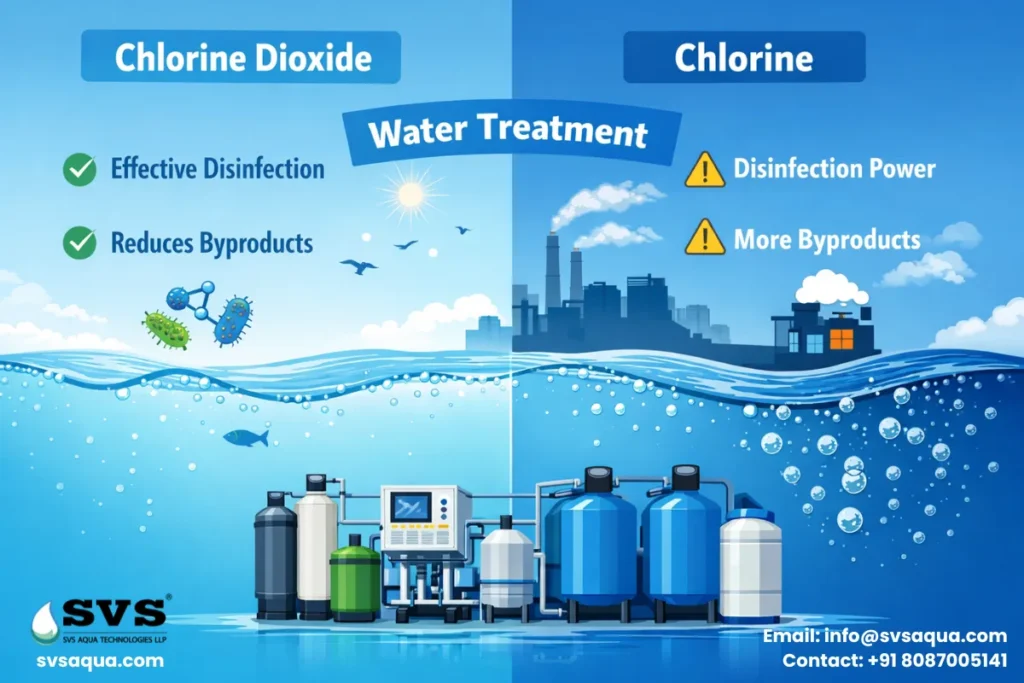
Why This Choice Matters in Real-World Water Systems
In India, water conditions are rarely stable. From fluctuating municipal supply to high organic load in industrial water, treatment is not as simple as it looks. That’s why choosing between chlorine dioxide vs chlorine water treatment is a critical decision.
Many businesses still rely on chlorine because it has always been the standard. However, as operations scale and compliance becomes stricter, its limitations start showing.
The goal today is not just disinfection, but consistent, safe, and efficient performance across varying conditions.
Engage With Us
Understanding the Two Approaches
- Chlorine – The Traditional Method
Chlorine water disinfection has been widely used across India due to its simplicity and accessibility.
- Easy to source and apply across different setups
- Lower upfront cost compared to advanced systems
- Familiar process for most operators
However, its performance depends heavily on water quality. In many Indian scenarios with high organic content, chlorine loses efficiency and requires higher dosing.
- Chlorine Dioxide – The Advanced Alternative (H3)
Chlorine dioxide water treatment is increasingly preferred where performance cannot be compromised.
- Maintains effectiveness across varying water conditions
- Less affected by organic impurities
- Delivers more stable and predictable results
It is commonly used in industries like pharmaceuticals, food processing, and large-scale industrial systems where reliability matters.
| Factor | Chlorine | Chlorine Dioxide |
|---|---|---|
| Effectiveness | Affected by impurities | Highly stable |
| Byproducts | Produces THMs |
Minimal harmful byproducts |
| Taste & Odour | Strong | Neutral |
| Cost | Low upfront | Better long-term value |
| Biofilm Removal | Limited | Highly effective |
Key Differences That Actually Impact Performance
Instead of theoretical comparisons, these differences directly affect day-to-day operations.
- Effectiveness in Indian Water Conditions
- Chlorine reacts with organic impurities and dissolved metals, reducing its disinfecting strength and making performance inconsistent across different water sources.
- Chlorine dioxide remains stable even in complex water conditions, allowing it to deliver consistent and reliable disinfection without being heavily affected by impurities.
Result: Chlorine dioxide performs far more reliably in real-world Indian conditions.
- Biofilm and System Hygiene
- Chlorine struggles to penetrate biofilm layers, often treating only surface bacteria while deeper contamination continues to grow within pipelines and systems.
- Chlorine dioxide effectively breaks down biofilm structures and eliminates bacteria at the root, improving system cleanliness and reducing long-term buildup.
This leads to improved system health and reduced maintenance requirements.
- Byproducts and Health Risks
- Chlorine forms harmful byproducts like trihalomethanes (THMs) when it reacts with organic matter, which are strictly regulated due to health risks.
- Chlorine dioxide produces significantly fewer harmful byproducts, making it a safer and more compliant option for long-term use.
This shift is why modern water disinfection methods are evolving beyond chlorine.
- Taste, Odour, and End-User Impact
- Chlorine often leaves a strong smell and unpleasant taste, which can affect user experience and product quality in sensitive industries.
- Chlorine dioxide maintains neutral taste and minimal odour, making it more suitable for applications like drinking water and food processing.
Higher-quality output leads to higher customer satisfaction.
- Storage and Handling
- Chlorine is easy to store and transport, making it convenient for smaller or less complex operations.
- Chlorine dioxide requires on-site generation and controlled handling, but offers significantly better performance once implemented.
Trade-off: convenience vs efficiency.
Cost vs Long-Term Value
At first glance, chlorine appears more cost-effective. However, long-term performance tells a different story.
With Chlorine:
- Higher dosage required in poor water conditions
- Additional cost for managing harmful byproducts
- Increased maintenance due to inconsistent performance
With Chlorine Dioxide:
- Higher initial setup cost
Lower chemical consumption over time - Reduced maintenance and operational issues
Over time, chlorine dioxide often delivers better value despite a higher upfront cost.
Where Each Option Fits Best
Chlorine Works Best When:
- Water quality is stable
- Systems are small-scale
- Budget constraints are high
Chlorine Dioxide Is Better When:
- Water quality is inconsistent
- Systems are large or industrial
- Hygiene and compliance are critical
This is why many industrial water treatment solutions in India are shifting toward chlorine dioxide.
Compliance, Safety, and Future Readiness
With increasing regulatory pressure in India:
- Chlorine systems face stricter control due to harmful byproducts
- Monitoring and compliance costs continue to rise
In comparison:
- Chlorine dioxide offers a safer profile
- Easier alignment with modern standards
It also fits better into a modern chemical water treatment process focused on safety and sustainability.
Final Take: It’s Not About Habit, It’s About Performance
Choosing between chlorine dioxide vs chlorine water treatment is no longer just about cost; it’s about performance, safety, and long-term reliability. While chlorine may work for basic needs, chlorine dioxide stands out as the better choice for modern water disinfection systems that demand consistency and compliance.
FAQs
Water in India often contains high organic content and impurities. Chlorine loses effectiveness in such conditions, while chlorine dioxide remains stable and continues to disinfect efficiently.
Yes. Chlorine dioxide can break down biofilm layers and eliminate bacteria at the source. Chlorine usually only treats surface-level bacteria and may not fully remove biofilm.
Chlorine is affordable, easy to use, and has been the standard for many years. For smaller systems or where budgets are limited, it is still a practical choice.
Yes. Chlorine dioxide is widely used in drinking water treatment because it does not significantly affect taste or odour and provides reliable disinfection.
Industries like pharmaceuticals, food processing, healthcare, and large-scale manufacturing prefer chlorine dioxide due to its consistent performance and higher safety standards.
Must Read
How Chlorine Dioxide Helps Prevent Bacterial Growth in Water Systems
Chlorine Dioxide Uses in Water Treatment
How to Use Chlorine Dioxide Tablets in Different Applications
Chlorine Dioxide Uses in Water Treatment