
Municipal Water Treatment Solutions: How Modern Systems Keep Tap Water Safe
- The Water Crisis Is A Big Problem
- Understanding the Real Challenges Cities Face
- The Solution: Why Modern Drinking Water Treatment Solutions Matter
- How Municipal Water Treatment Systems Actually Work
- Real Results: Where This Works in Practice
- Industrial Water Treatment Solutions for Businesses
- The Case for Wastewater Treatment Solutions
- Key Advantages and Safety Standards in Advanced Treatment Systems
- Why Municipal Water Treatment Solutions Are Important
- FAQs
- The Path Forward
Engage With Us
The Water Crisis Is A Big Problem
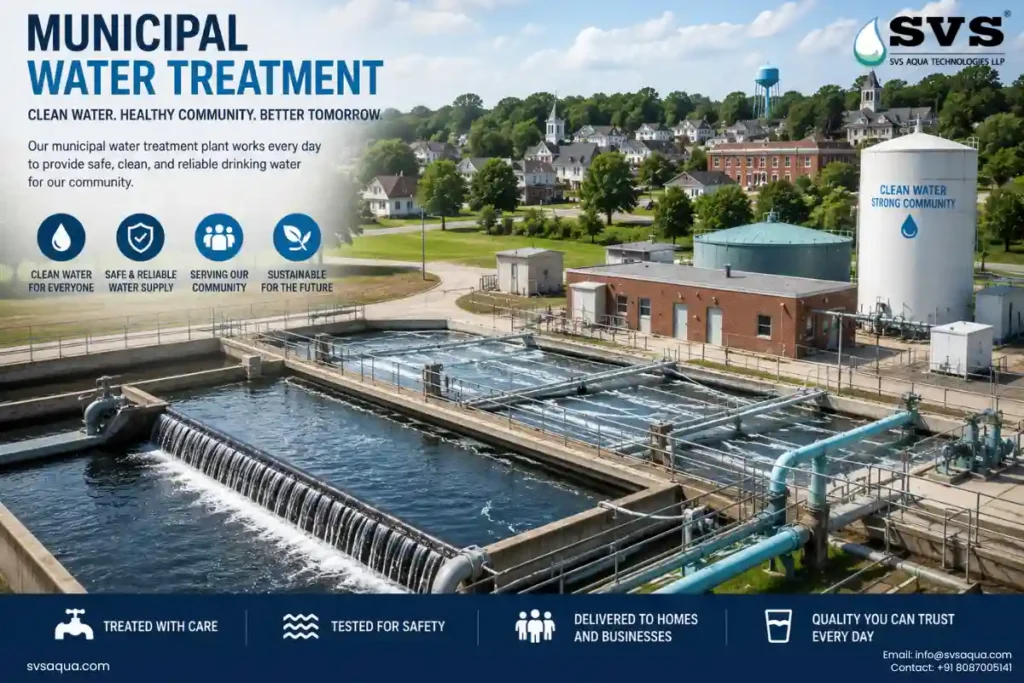
Every day, millions of people turn on their taps expecting clean and safe water. However, contaminants, bacteria, ageing pipelines, and industrial pollution pose serious challenges to maintaining water quality. This is why modern Municipal Water Treatment Solutions play a critical role in protecting public health and ensuring a reliable supply of safe drinking water.
A lot of people in India, about 678 million people, do not have access to proper toilets and other sanitation facilities. The water on the surface is contaminated, and the pipes are old. There are bad bacteria and viruses everywhere, so it is hard for cities to give people what they should have: clean water.
The challenge is not only water scarcity but also water quality. Contaminants from industries, agriculture, and ageing pipelines make effective Municipal Water Treatment Systems essential for providing safe drinking water. The water has things in it from factories, farms and old pipes. This is where the people who take care of our water need to do something. They need to make sure our water is clean and safe to drink. This is where Municipal Water Treatment Solutions come in. They are very important.
- The Water Crisis Is A Big Problem
- Understanding the Real Challenges Cities Face
- The Solution: Why Modern Drinking Water Treatment Solutions Matter
- How Municipal Water Treatment Systems Actually Work
- Real Results: Where This Works in Practice
- Industrial Water Treatment Solutions for Businesses
- The Case for Wastewater Treatment Solutions
- Key Advantages and Safety Standards in Advanced Treatment Systems
- Why Municipal Water Treatment Solutions Are Important
- FAQs
- The Path Forward
Engage With Us
The Evolution of Fruit Washing and Water Disinfection
Municipal authorities face several challenges in maintaining safe water supplies. These include microbial contamination, biofilm formation, heavy metal accumulation, ageing infrastructure, and rising operational costs.
Bacterial contamination, like E. coli, thrives in untreated water. Viruses spread quickly without proper disinfection. Biofilms develop inside pipes, making it nearly impossible to maintain water quality. Heavy metals accumulate in the system. And funding? That’s another nightmare. Municipalities struggle with the financial burden of operating large tertiary treatment plants, requiring significant annual expenditure for membranes, power, and chemicals.
This isn’t a problem that will solve itself. It requires smart technology and proven methods.
The Solution: Why Modern Drinking Water Treatment Solutions Matter
Good news. We have the technology to solve this problem now.
Drinking Water Treatment Solutions have improved a lot since the days of just using chlorination. Today’s approach is better, safer and works well. The biggest breakthrough?
Chlorine dioxide is really effective against bacteria, viruses, moulds, yeast and fungi. It stays effective when the pH level is between 3 and 10. Unlike chlorine, it doesn’t create bad chemicals, like trihalomethanes, that can hurt people in the long run.
Think of chlorine dioxide water treatment as a comprehensive defender for your water system:
- Kills harmful microorganisms effectively at lower doses
- Breaks down biofilms that hide bacteria
- Works across different water sources and conditions
- Produces minimal environmental waste
- Doesn’t leave chemical residue that damages pipes
How Municipal Water Treatment Systems Actually Work
When a city deploys a modern Municipal Water Supply Treatment system, it typically involves multiple stages:
Stage 1: Pre-treatment
The water we get from the start goes through a filter to remove big pieces of stuff, dirt and other things that can block the filters.
Stage 2: Chemical Treatment
This is where we use Water Disinfection Chemicals like chlorine dioxide. These chemicals go after the living things and get rid of the bad stuff we do not want. Chlorine dioxide works well and breaks down into harmless things like chloride and chlorite, which are much better for the water and the fish.
Stage 3: Filtration
Now we use good filters to remove the tiny pieces that are still in the water and make it clearer. Some systems use filters made from old glass that has been recycled, which is good for the earth and works really well.
Stage 4: Final Disinfection
We make sure the water is still clean as it goes through the pipes to our homes and workplaces, so it does not get contaminated on the way.
Stage 5: Quality Testing
We always check the water to make sure it is safe for people to drink before it gets to them. We want to be sure the water is good and clean for everyone to use.
Real Results: Where This Works in Practice
Let’s look at actual success stories. Johns Hopkins Hospital in Baltimore installed chlorine dioxide water treatment systems in its inpatient buildings beginning in 2001 and conducted an extensive evaluation of the system’s safety and efficacy for Legionella control throughout its potable water system. After more than 20 years, the system continues to perform reliably.
In Ghaziabad, a newly established 40 million liter per day advanced tertiary treatment plant supplies treated water to 1,400 industrial units across the city, demonstrating how modern infrastructure can scale to meet massive demand.
These aren’t laboratory experiments. They’re real facilities handling millions of litres daily, proving that advanced systems deliver results consistently.
Industrial Water Treatment Solutions for Businesses
But this isn’t just about municipal supplies. Industrial Water Treatment Solutions are equally critical. Beverage companies, dairy producers, pharmaceutical facilities, and cooling tower operations all depend on treated water.
A dairy factory needs ultra-pure water to prevent product contamination. A power plant requires consistent water quality to maintain efficiency. These operations can’t afford downtime due to water quality issues. Modern water treatment systems ensure they operate smoothly while meeting regulatory standards.
The Case for Wastewater Treatment Solutions
Here’s something many people don’t realise: treating water doesn’t end with drinking water. Wastewater Treatment Solutions are becoming increasingly important as cities focus on circular economy principles.
India’s Safe Reuse of Treated Wastewater Framework aims for 50 per cent reuse of treated wastewater by 2025 and 100 percent by 2050, positioning water reuse as a key element of India’s water security.
Modern systems don’t just clean wastewater for discharge. They clean it to a quality where it can be reused for industrial applications, agriculture, and even toilet flushing in buildings. This dramatically reduces freshwater demand on limited sources.
Key Advantages and Safety Standards in Advanced Treatment Systems
When cities invest in comprehensive water treatment solutions, they gain multiple benefits while maintaining the highest safety standards:
Quality and Performance Benefits:
- Continuous testing ensures water meets or exceeds safety standards
- Lower chemical doses mean reduced operational expenses
- Fewer harmful byproducts and reduced chemical consumption
- Systems designed for consistency even during peak demand
- Solutions that grow with your city’s population and needs
Safety and Maintenance Protocols:
- Modern treatment facilities employ trained professionals who understand chemical handling, system operation, and safety requirements
- Equipment includes sensors that monitor residual chemical levels, preventing overdosing or underdosing
- Proper protocols ensure these systems are safe for both operators and consumers
- Regular maintenance schedules prevent system failures and ensure optimal performance
- Real-time monitoring systems alert operators to any irregularities immediately
Why Municipal Water Treatment Solutions Are Important
Clean water is something most of us take for granted. We turn on the tap and expect the water to be safe for drinking, cooking, and daily use. But behind every drop of water supplied to homes, schools, hospitals, and businesses is a complex treatment process designed to protect public health.
Modern Municipal Water Treatment Solutions are essential because they remove harmful bacteria, viruses, chemicals, and other contaminants that can cause serious health problems. Without proper treatment, polluted water can lead to waterborne diseases and affect the well-being of entire communities.
These systems also help cities manage increasing water demand as populations continue to grow. Advanced treatment technologies ensure a consistent supply of safe drinking water while reducing the impact on natural water sources. In addition, they support environmental sustainability by enabling water reuse and minimising pollution.
Reliable Municipal Water Treatment Systems are not just about meeting regulations-they are about providing people with access to clean, safe, and high-quality water every day. As water challenges continue to increase, investing in effective Drinking Water Treatment Solutions is becoming more important than ever for building healthier and more sustainable communities.
FAQs
Municipal Water Treatment Solutions are processes and technologies used to remove contaminants and disinfect water before supplying it to homes, industries, and commercial facilities.
Common Water Disinfection Chemicals include chlorine dioxide, chlorine, ozone, and coagulants used to eliminate microorganisms and improve water quality
The thing is, traditional chlorine creates byproducts like trihalomethanes. This is where chlorine dioxide comes in. It provides disinfection without these issues. Chlorine dioxide is a choice because it does not produce these harmful byproducts.
If you live in an area, there are still options available. Smaller-scale solutions exist, including tablets, powders and portable systems designed for village-level applications. These solutions can provide drinking water even in areas where big treatment plants are not available.
Yes, treated water is safe for cooking and drinking.
Municipalities conduct testing at treatment plants and distribution points. You can request water quality reports from your water authority to find out if your water is safe.
The byproducts of water treatment are minimal and carefully managed. Modern systems produce byproducts that are either naturally occurring compounds or carefully disposed of following environmental regulations.
The Path Forward
Modern Municipal Water Treatment Solutions are essential for delivering safe and reliable water to communities and industries. Advanced technologies such as Chlorine Dioxide Water Treatment, efficient Water Disinfection Chemicals, and sustainable Wastewater Treatment Solutions help municipalities improve water quality, protect public health, and support future water demands. As cities continue to grow, investing in modern Municipal Water Treatment Systems will remain critical for ensuring long-term water security and environmental sustainability
Must Read
Why Your Industry Needs Reliable Water Treatment Chemicals Manufacturer Solutions
Wastewater Treatment Solutions, Water Treatment Products
Best Poultry Water Treatment & Biosecurity Solutions for Farms
Wastewater Treatment Solutions, Water Treatment Solutions